Cute. Music reminiscent of Pink Panther beginning at 3:24.
I’ve watched three YouTube segments of “Beware of the Car,” which will be the 3rd Eldar Ryazanov film I’ve seen.
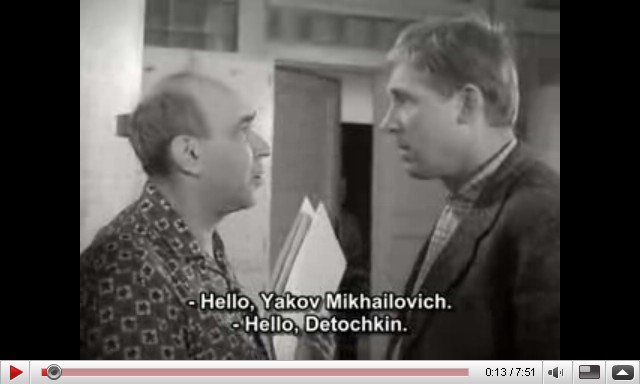
When I saw this (in segment 2) I thought the guy on the left might be Ryazanov himself. But I guess it’s not.
The scene is in an insurance office, and the main character of the film (on the right) is an insurance agent. The guy on the left is his boss.
I was taken aback by the idea that there was such a thing as property insurance in the Soviet Union. It seems such a capitalist thing. In fact, the following paragraph in an academic journal article about Soviet insurance almost took the words out of my mouth, except that my thoughts on the subject weren’t quite this clear:
Insurance is closely related to the origins and growth of modern capitalist economy and the insurance contract has been identified as the springboard by which small-scale itinerant commerce of the early Middle Ages vaulted into large-scale enterprise of modern capitalism. How, then, can insurance be fitted into a non-capitalist framework and what role can it play?
The quote is from “A Survey of Insurance in the USSR”, by Paul P. Rogers, in The Journal of Insurance, Vol. 30, No. 2 (Jun., 1963), pp. 273-279, published by the American Risk and Insurance Association.
This Paul Rogers also did other writing on the topic. I read a couple of his shorter works, including this 1963 article as well as one published in 1980.
A few things that I learned:
Insurance was a government monopoly, run by an organization called GOSSTRAKH (General administration of Government Insurance.) Insurance was available for agricultural and transportation. Even in a welfare state there was such a thing as life insurance and disability insurance. Insurance was also available for personal property. The purchase of insurance was mandatory for some purposes, and a matter of individual choice in others.
I presume the insurance agents did not work on a commission.
Regarding auto insurance, Rogers’ 1980 article says this:
Citizens may insure vehicles under a separate policy. The policy insures automobiles, motorcycles, mopeds, snowmobiles, sailboats and rowboats for property damage. There is no liability insurance coverage.
I suppose if there had been liability insurance, the premise of that other Ryazanov film, Railway Station for Two (Vokzal dlya Dvoikh) would have been different.
BTW, I am trying to figure out how to use Cyrillic characters in a Wordpress blog set up for use primarily in English. So far I haven’t learned a way to do it.


very interesting notes
///I presume the insurance agents did not work on a commission. ///
On the contrary, they worked on a commission and on a salary. There was mixed system…
But, perhaps, the commission was not straight percentage share from every contract. I think it was some mathematic formula, with which was calculated a general sum of the commission.
Plus, of course, there were bonuses for insurance agents (instance, in the final of quarter or/and year).
So, this system was quite flexible, I suppose.
I think this flexibility permited to main character (Detochkin) so freely to conduct himself according to his job (holidays, medical certificates etc).
Probably, Soviet insurance system was transforming during the decades – and the system of commission too… Unfortunately, I don’t know the detailes.
///I thought the guy on the left might be Ryazanov himself. But I guess it’s not.///
I think in these times Ryazanov was more attractive gentleman
Here is the photo of 1960s:
http://moikompas.ru/img/compas/2008-11-18/eldar_ryazanov/98764898_orig.jpg
I remember that Eldar Ryazanov said how he was angry when he has seen a small bald patch in his head in the shot in The Irony of Fate (where he plays the small role). He shouted at the assistants and the actors… But they were surprised with his wrath, because they saw his bald patch every day. For him it was the break-down…
———-
P.S.
As for Soviet insurance…
I remember the one of the earlier Soviet-American TV show (TV bridge) in 1980s, where an American woman confessed that she was surprised with Russian/Soviet women use the cosmetics.
For her it was the break-down too…
By the way, I highly recommend the popular-documentary series “Namedni 1961-2003: Nasha Era” (produced by Russian NTV channel in 2000s) – “Soviet/Russian Cronicles 1961-2003: Our Era” (I’d translate it so way). It is 45-minures episodes in documentary-educational-entertaining form, every year in life of USSR/Russia – one episode. Very interesting and well-done!
Author Leonid Parfyonov is popular and loved journalist in modern Russia.
http://www.imdb.com/title/tt0764146/
http://russart.com/movie-info-34-Namedni-Nasha-Era-1961-2003
By the way, here is the beginning of first episode from the “Namedni” series (episode about 1961)
http://www.youtube.com/watch?v=tE1sw5sBMYs
In Russian, sorry
John
I have found Mark Zakharov’s film “Formula of A Love” on YouTube,
but, seems, there are no English subs
Here is fragment 1:
http://www.youtube.com/watch?v=MxYnpufhUm0
By the way, yet here are files with Eng. subs to Russian films:
http://subtitry.ru/subs/ENG/
Thanks for all the suggestions, Alex. That Leonid Parfyonov series looks very interesting. I’ll see if I can find it. I hope to write some posts partly in response to your other comments. -John
[...] It’s not as though such a mixture of roles has never been done, though. Last winter I was surprised to learn that the USSR had such a thing as insurance. The 1966 Eldar Ryazanov movie, Beregis Avtomobilya (Beward of the Car), features an insurance agent who does a little noble larceny on the side. (Kino Reticulator blog article here.) [...]