Reticulator


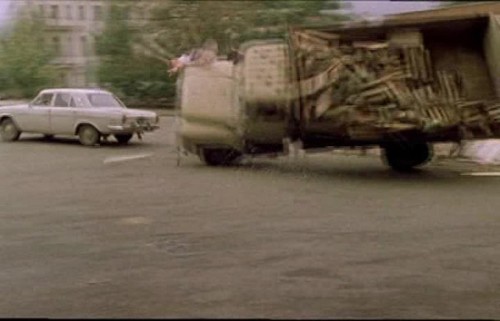
A few weeks ago I learned about the Georgiy Daneliya film, “I Walk Through Moscow”.    In some places it’s spoken of as reminiscent of the French New Wave films of its time.   It was interesting enough to re-watch, and it’ll bear further re-watching.

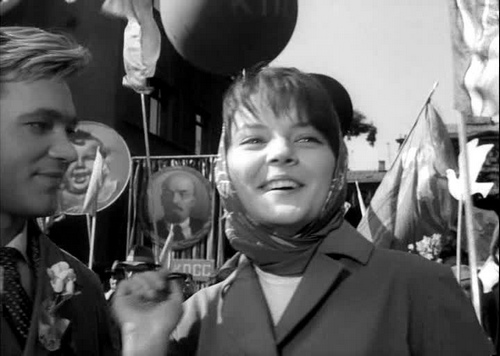
I’d say it’s a very good film except for one thing:  I had already seen “I am Twenty,” a work by Martin Khutsiev.  It also features young people on the streets of Moscow, and it, too, has been described as reminiscent of the French New Wave films.

I am Twenty“I Walk Through Moscow” is very superficial in comparison.  The characters are interesting but shallow in comparison.   And its camera work, while fun to watch, is nothing compared to “I Am Twenty.”

The Khutsiev film was begun in 1959, but not released until 1965 or 1966.   Khrushchev had denounced it, revisions were made, and still it was not released for wide distribution for several years.  In the meantime “I Walk Through Moscow” came out.

It makes me wonder if Danieliya’s film was a politically correct version that was made in response to Khutsiev’s film.   I have tried using Google to find out, but have not been very successful in finding any articles that compare the two.


Александр Михайлов in Love and DovesIt wasn’t easy to watch some parts of Love and Doves while listening to Jared Diamond’s book, Guns, Germs, and Steel.  (Not that I was doing the two simultaneously.)  Diamond explains how many epidemic diseases have arisen in human societies where people live in agricultural communities  in close contact with domestic animals.

Maybe Alexander Mikhailov’s character was a one-of-a-kind, though.    At least I had never before seen mouth-to-mouth contact with doves.   Maybe it’s best that the actor hadn’t had a chance to read Diamond’s book before playing his role.


Over at Cape Girardeau History and Photos, Ken Steinhoff posted a 1960s photo of a man wearing a straw cap of what I call the French Foreign Legion style.   It elicited some admiring comments.

It also reminded me of another type of hat from the same era — A type of dress hat that I’ve seen in at least two Russian movies.   These are not movies from the 1960s, but are set in the late 50s and 60s.   The first is Serye Volki, in which Nikita Khrushchev and Anastas Mikoyan are wearing see-through dress hats.  I presume these were considered good for the relatively warm weather of Crimea, although in this case it was October 1964 and Khrushchev was in the process of being removed from power.

The hat is so transparent that you can even see Khrushchev’s (Rolan Bykov’s) bald head through it.

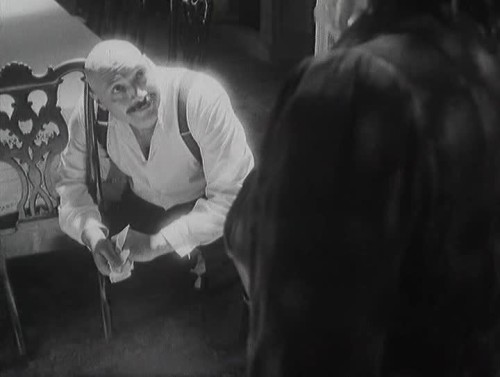
This hat, worn by the Savva Ignatevich character in Povrovskiye Vorota, is not quite as transparent, but in the movie (as opposed to screenshots) you can more easily see that it’s a porous material.   It goes well with his white summer suit.

Were hats like these ever worn in the United States?   I don’t recall ever seeing any, but then, where I lived as a kid I  never saw a man wearing a white summer suit, either.   I’m pretty sure they existed.

One thing we didn’t have in the U.S. (unfortunately) is the kind of Ukrainian shirt the Khrushchev and Ignatevich characters are wearing.  I presume there’s a name for it but I don’t know what it is.  (I’m not even sure it’s Ukrainian, as opposed to Russian.)


The more I watch it, the more I regard Tot samyy Myunkhgauzen as one of the greatest films of all time.

[Warning:  You might want to watch it before reading any more of this.]

Tonight I’ve been re-watching this scene in which the Burgomeister (Igor Kvasha) tries to avoid testifying that his friend, Karl (Baron Münchausen) is really not Baron Münchausen but the gardener Müller.    You could say it’s a matter of career vs friendship, and of one kind of friendship vs another, for the Burgomeister.    And it probably is not just a casual friendship, because the Burgomeister is the only person who shows no surprise at seeing Münchausen come back from the dead.  He’s not the only one who knew he wasn’t really dead, but he’s the only one who takes his reappearance calmly, which implies that they had been in touch.

For Münchausen the issue is a matter of life and death, but that’s minor compared to the larger issue at stake.  For him, the worst outcome is for his friends and family to lie to save his life.   It’s not quite that simple, though, which is one of the things that makes this movie good.  It takes a while to catch all the nuances.

Kvasha is superb here in acting out the the conflict this makes for him.   It’s good for a laugh, but it’s a deadly serious comic situation.  (At the end, when the issue of life and death cannot be put off, Münchausen tells us our problem is we take things too seriously.   Which does not mean it’s no longer a life and death situation.)

Almost everything about the film is perfect.    The only part I wish would have been done a little differently is this scene involving Münchausen’s ex-wife (superbly played by Inna Churikova) and the woman who loves him (also well played by Yelena Koreneva).   I wish the filmmakers had not used this dramatic, high-contrast lighting to make her look sinister, because it just isn’t necessary to make the point about what is going on.   Thus far in the film she has done everything without that gimmick.  Among other things, she shows her contempt for all the men in her life who don’t live up to her ex’s standards.  Which means all of the men — including lovers, her son, and those she is using to get her ex out of the way.

So this lighting looks a little out of place with the rest of the film, though only slightly out of place.   It’s just a wild guess, but I wonder if this scene was filmed early in the process, perhaps before the filmmaker (Mark Zacharov) finalized his approach to the whole project.

In the same scene Münchausen’s ex says that yes, Marta should tell the truth, but what kind of truth would she tell?  Marta, who has had a difficult time with the Baron’s peculiar obsession with truth, replies, “правда одно”.

I’ve been thinking about the version in these English subtitles, “Truth is unique.”   That’s not a wrong translation, but I wonder if it might not convey the important point, given the various connotations of the word “unique.”   I guess I would have found a more literal translation like “Truth is one” to have had more impact if all I had to go by was the subtitles.   But perhaps  “truth is unique” is better than a wordier “there is one truth,” which sounds too preachy and off-topic for the situation.    The tone of voice in which it is said perhaps conveys the meaning regardless of the translation.

I wish I could understand everything else without the subtitles.

This is a film for which Russian subtitles are available, so next I’m going to do is watch it with those.   Maybe I’ll learn a few things.

Speaking of translations, it’s interesting the various ways in which the title of the film gets translated into English:

  • That very Munchausen
  • The very same Munchausen
  • Munchausen
  • The One and Only Munchausen
  • The Real Munchausen

The latter two were versions I found in news items that appeared in U.S. newspapers after Grigory Gorin, the writer of the script and of an earlier stage version of the story, died in June 2000.

[Morning-after edits made, 8 May 2011]


Last weekend I watched Neokonchennaya pyesa dlya mekhanicheskogo pianino again — the first time in maybe a year.

The boy in the screen shot is playing a recording of what sounded like something from an Italian opera.  I don’t know much about opera, but I got to wondering what it is, and what it’s significance is.

It turns out that somebody already asked about it at answers.com.  The answer:  It’s the aria, Una furtiva lagrima, from  Gaetano Donizetti’s  L’elisir d’amore.     Wikipedia has the lyrics with an English translation, as well as a recording done by Enrico Caruso in 1911.   My untrained ear likes Caruso’s rendition of it more than any of the others I’ve found on YouTube.   The one in the film is pretty good, though.   In the closing scenes we get to hear the complete aria, as opposed to the fragments that were played earlier.

I dug out my wikipedia password and updated the aria’s page to add Unfinished piece for player piano to the list of films in which it is heard.

As to the significance of using that piece, I suppose it fits the film because it’s about sweet illusions of love, of which there are a few in the film.   It also fits in that it’s about the gulf between different socio-economic classes

A side note.  The opera comes from a period of special interest to me.   It premiered on May 12, 1832, which was two days before the battle at Stillman’s Run, the violent clash that set off the Black Hawk war.

I almost forgot to mention that it’s on video.google.com, with English subtitles.


I’ve watched Pokrovskiye Vorota at least twice before, but on my latest watching, toward the end, I detected a fleeting smile from Lyudochka that I was sure I had seen before.   It comes just as she’s about to kiss Lev Khobotov (Anatoli Ravikovich) again.   It’s hard to capture in a screenshot, but it’s a little different from anything else she has done in this film.

After a half-hour of scratching my head, I remembered.    The woman who plays Marta in That Very Munchausen has a smile like that.

And sure enough, it’s the same actress, Yelena Koreneva.   That’s pretty good for her to play those very different characters in very different ways.


vlcsnap-00019

Now I wish I hadn’t put off watching Obyknovennoye Fascism (Ordinary Fascism) for so long. I didn’t expect something like this at all. Yes, it gives the leftwing version of the social origins Hitler and Nazism, which is pretty much the same story as you get in documentaries made in the United States. But it sometimes strays and becomes more informative than anything I would have expected from either the Soviet or U.S. media.

It’s produced and narrated by Mikhail Romm, using a lot of footage that I presume was captured at the end of the war. The story is told with a wry humor — not at all the strident tone I had expected. (I say this based on the first 40 minutes. It wasn’t easy to make myself stop at our daily quota mark.)

kalinovski

After the first 20 minutes, I remembered where I had encountered this style before. It was in Kalinovski Square, which tells about the 2006 election of the Belorussian dictator, Aleksandr Lukashenka and his dissidents. The web site for the documentary has this blurb:

“In this hilarious and entertaining yet hard-hitting documentary, veteran director Yuri Khashchevatski pokes fun at the powerful elite in his home country of Belarus by telling his version of the truth—and illuminating the absurdity of reality. His preferred method of dealing with heavy topics is a light touch of a sharp knife—followed by a quick twist of the blade and a little salt in the wound.” — Silverdocs, Bill Gilcher.

vlcsnap-00021

I’ve got to wonder if Khashchevatski consciously copied the technique of Mikhail Ramm. The above scene featuring the bumbling Chancellor Hindenburg was done much like the one pictured in the screen shot of Lukashenka. The narrator’s voice, the tonal qualities, the timing, the relationship of narrator to subject and to audience — all very much alike in the two documentaries, one of which was done in the mid 1960s and the other fairly recently.


vlcsnap-00013

When I saw this young guy with the chipmunk jowls (the shorter of the two bridegrooms) I was sure I had finally found a film where Oleg Tabakov plays a sympathetic character. The film is “Из Ада в Ад” (“From hell into hell” or “From one hell into another”).  There is hardly any English-language information about it on the web, but  it seems it was made too recently (1996?) for Tabakov to be that young.   Besides, it’s not him.   It might be Mark Goronok, if my picture-matching at kino-teatr.ru is any good.


vlcsnap-00003

That sounds like Vladimir Vysotsky’s voice on that tape recorder, though his guitar is not strung as loosely as he sometimes had it. (Click through to go to a YouTube video of this scene, at 6:20). It seems that Ivan Grozny is starting to like to it. (He’s visiting from the 16th century, in the 1973 comedy film, Ivan Vasilievich Changes Professions.)

I presume I’m not catching the entire significance of matching up Vysotsky with the Tsar.


vlcsnap-00021

In the October 4 issue of The Weekly Standard, Thomas Swick tells about a literary cruise in the Aegean that included a reading list. (“Passenger’s List : Cruising the Aegean with a company of bibliophiles“) One passage toward the end reminded me of some Russian movies:

But one morning I spent an hour in the library reading…. In Cefalu we visited the great Norman cathedral…and then repaired to the café in the square in front. At a nearby table three young women in white summer dresses sat reading books. I asked them where they were from.

“Sweden,” said one of the two blondes.

I told her what an unusual sight it was for me to see a trio of twentysomethings not talking or texting but lost in books.

“In Sweden, too,” she said. I almost invited them back to the ship.

I don’t know about a trio of young women, but in Russian movies there are scenes of solo young women reading books, usually on public transit. Probably the most attractive one I ever saw is this one in Mne Dvadcat Let. This young woman is so engrossed in her book that she never notices the fine looking young man who is watching her closely. I don’t know if such a scene is possible, but it is very nicely done. She reacts to what she is reading, but is oblivious to everyone else. She is aware enough to move to the empty window seat when it becomes open, and does her part to relay the money that is passed from hand to hand from someone on one end of the bus to the conductor on the other end, and the same for the ticket that makes the return trip. And she doesn’t miss her stop. But she is thoroughly caught up in her reading.

I was kind of hoping to learn just what book she was reading, but we never find out, even though boy does finally meet girl. He should have asked her.

It was a fine bit of film-making just the same.

© 2012 Kino Reticulator Suffusion theme by Sayontan Sinha
Easy AdSense by Unreal